
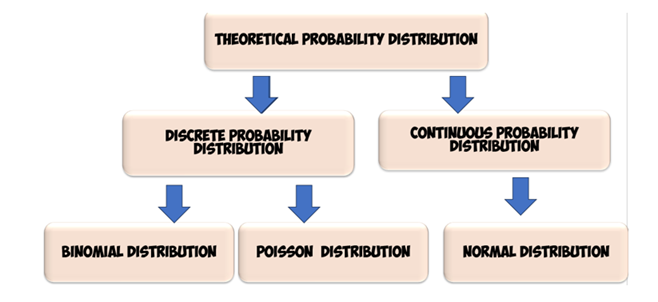
In real life we (individual and corporate) generate several data that may resemble theoretical distribution. We observe
- Number of female children in a family
- Number of defective batteries in a production line
- Number of employees earning salary more than 100000
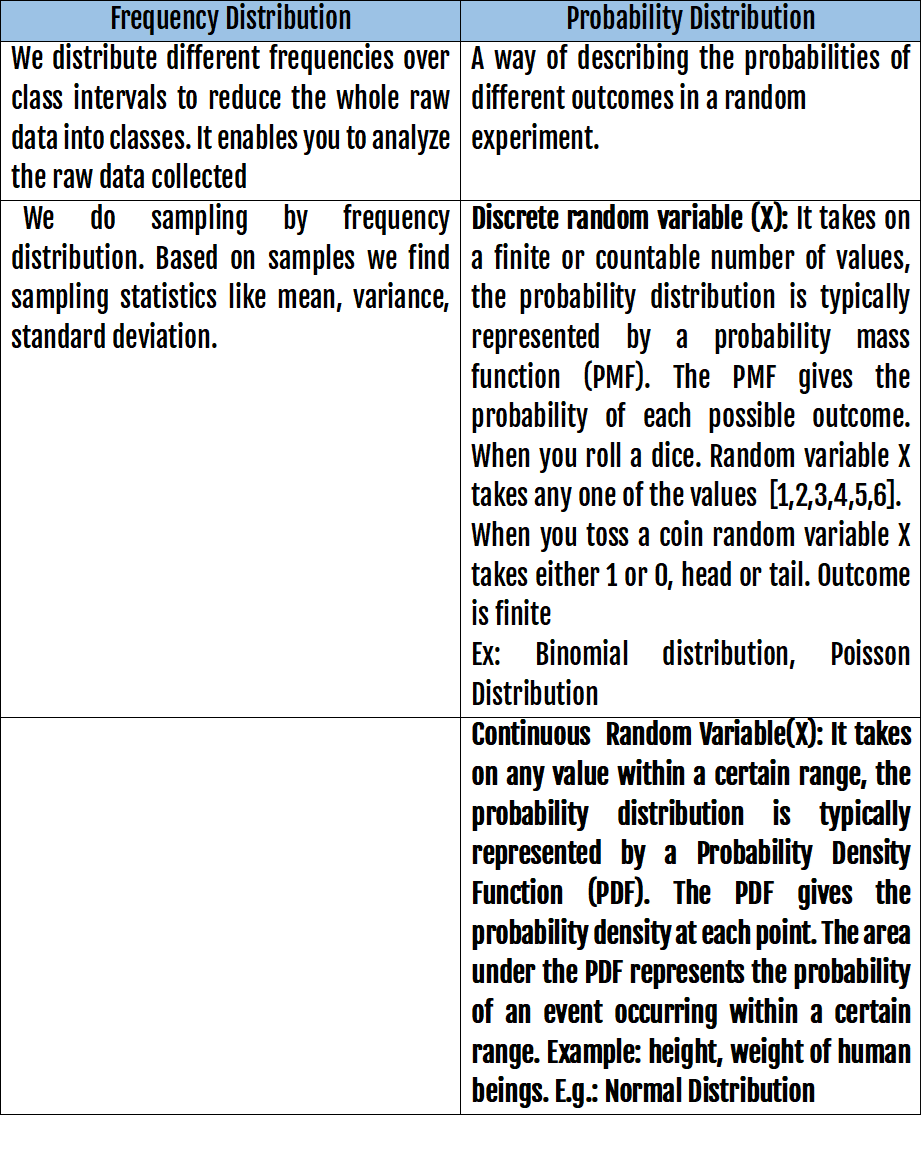
We have already seen the frequency distribution. How raw data is grouped under different class-intervals and frequencies for each class interval are found out. This is to simplify the huge data into a manageable data. Instead of frequency we find probability of each data points.
The total probability (one) is distributed to different mass points(pmf) in the case of Discrete random Variable X or to different class intervals in the case of Continuous Random Variable X.
This type of probability distribution is known as Theoretical Probability Distribution. It remains only in theory
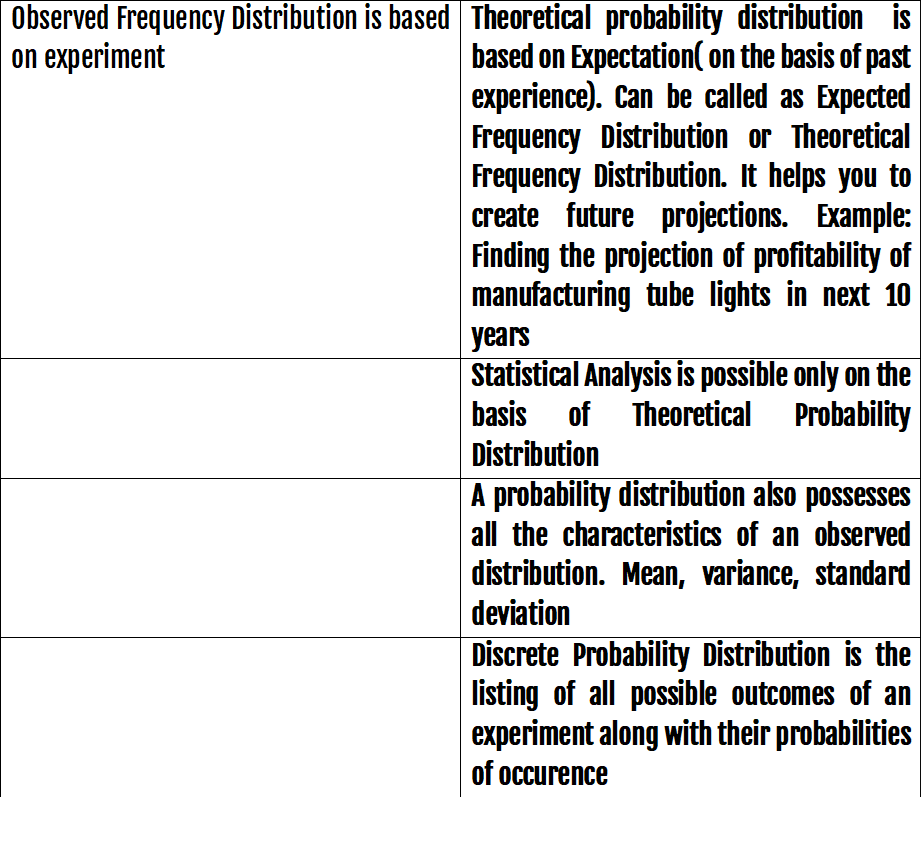
You can collect samples with two different ways. Sampling refers to the process of selecting a subset (a sample) from a larger population.
Sampling with Replacement:
If sampling is done with replacement (person or item selected from the population is observed, then put back into the population), the probability p will be constant from one trial to the next. Example: For example, a bag contains 3 balls with different colors red, blue, and green. if you are drawing red color ball from a bag, sampling with replacement means that after you pick a ball, you put the red ball back in the bag before making the next selection. This way, each draw is independent, and the total number of possible outcomes remains the same after each selection. The probability of selecting red, blue, green ball remains constant 1/3
Steps Involved: Say you want to select sample of balls in color red,blue green from a bag containing 3 balls
- Select an item randomly from the population.
- Record the selected item.
- Replace the item into the population.
- Repeat the process until the desired sample size is achieved.
Conditions:
- Each selection is independent
- It is possible to select the same-colored ball (because of replacement)
- Consistent Probability: The probability of selecting each ball remains constant
Sampling without Replacement:
Sampling without replacement refers to the process where an item, once selected, is not returned to the population for further selection. This means that once an item is selected, it cannot be chosen again in the same sampling process. It’s commonly used in real-world surveys and randomized splits
Steps involved
- Select an item randomly from the population.
- Record the selected item.
- Remove the selected item from the population.
- Repeat the process until the desired sample size is achieved.
Conditions:
- Dependence: Each selection is dependent on the previous selection
- No repetition: It is not possible to select the same-colored ball (because of non-replacement)
- Changing Probability: The probability of selecting each ball will not remain constant/same
Sampling without replacement is more commonly used in real-world studies In sampling without replacement, the population size decreases after each selection, and the probabilities of selecting each remaining individual or item change over time.
The statistical distributions are useful for us
- to model data,
- to calculate probabilities.
Based on above we can come to a conclusion that which distribution fits our given data.
For calculation of probability, we have
- Probability Mass Function (PMF) – meant for Discrete Random Variable (X)
- Probability Density Function (PDF) – meant for Continuous Random Variable (X)
- Cumulative Distribution Function(CDF) – meant for Continuous Random Variable (X)