
Under Discrete Probability Distribution we have
- Bernoulli Distribution
- Binomial Distribution (sampling with replacement)
- Hypergeometric Distribution(Sampling without replacement)
- Poisson Distribution
Bernoulli Distribution:
- Discovered by a SWISS Mathematician Jame Bernoulli(1654-1705)
- Also known as Bernoulli Distribution
- A successive repetition of an experiment is called Bernoulli Trials.
- The number of trials is finite and fixed
- Dealt with dichotomous classification of events(outcomes) either 0 or 1
- Non-occurrence or Occurrence of an event
- Occurrence is denoted by p
- Non- occurrence is denoted by q
- Outcome of each trial may be either success or failure. Trials are independent. Example: Flipping a coin.
- When trials are done n times under identical conditions Say Xi for i= 1 to n assumes values 0 or 1 then Xi is Bernoulli Variate with probability ‘p’
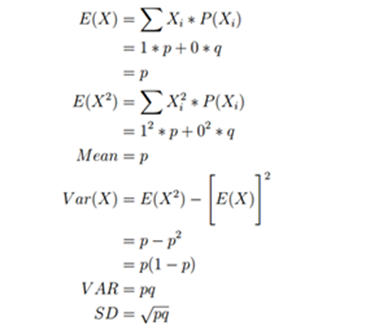
- Mean of Bernoulli Distribution
- Here random variable assumes values 1 and 0 with probabilities ‘p’ and ‘q’
- q = 1-p; Here random variable is called Bernoulli Variable.
- It has only one parameter ‘p’ that is one constant
- For different values of p we get different Bernoulli Distribution. (0<p<1)
Example:
- a card is drawn from a pack of 52 cards.
- The probability of getting a king is 4/52.
- Before a second draw, the card drawn is replaced. (drawing with replacement)
- But if the card is not replaced, we cannot have binomial distribution.
- Tossing of a coin: a head or a tail can be had on a toss of coin ;
- Drawing from a pack of cards: a card drawn may be black or red
- Inspecting a batch: An item in a batch may be defective or non-defective
When a coin is tossed
- you get two possible outcomes. Either Head or Tail
- The probability of getting a Head is (p) ½
- The probability of getting a Tail is (q= 1-p) ½
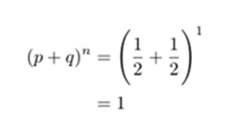
- Sum of all probabilities = 1
When two coins are tossed
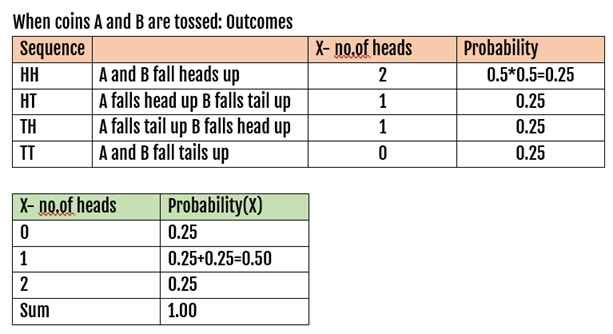
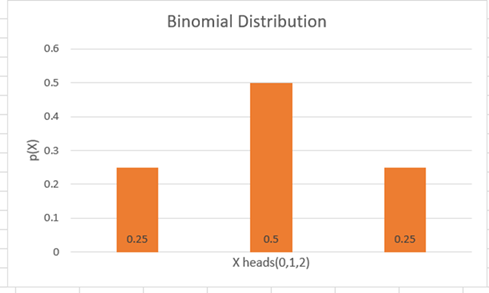
The possible sequences are mutually exclusive( only one can happen for each toss). The sum of joint probabilities is equal to one. For The probability of HT and TH we use addition rule P(HT OR TH) =P(HT)+P(TH)= 0.25+0.25=0.50
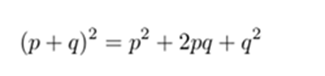
- Probability of two heads up = p*p = p square
- Probability of one head and one tail = pq +qp = 2pq
- Probability of two tails up = q*q = q square
The sum is
Characteristics of a discrete probability distribution:
- For any value of X 0≤P(X)≤1
- The values of X are exhaustive. The probability distribution includes all possible values
- The values of X are mutually exclusive: Only one value can occur for one experiment
- The sum of their probabilities is one ;ƩP() = 1
When three coins are tossed:
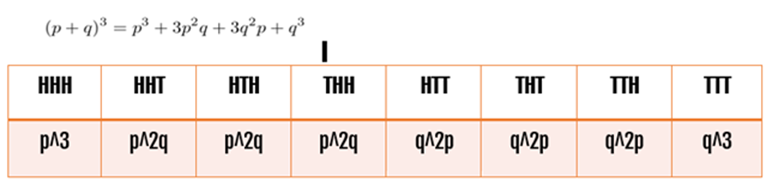
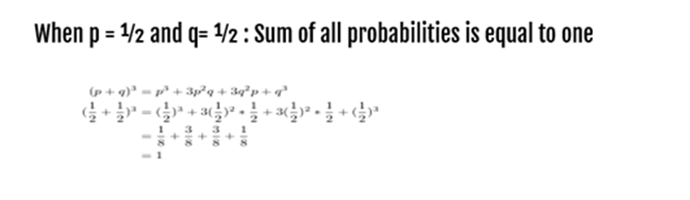
Calculation of Mean, Variance and Standard Deviation of Random Variable X:
Let the probability of the person being interviewed Male – 2/3 and Female – 1/3 . Find mean and SD of the distribution.
- p+q = 2/3+1/3 =1
- Mean (E(X) = p = 2/3
- Var(X) = pq = 2/3*1/3= 2/9
- SD(X) = √2/9 =0.4714
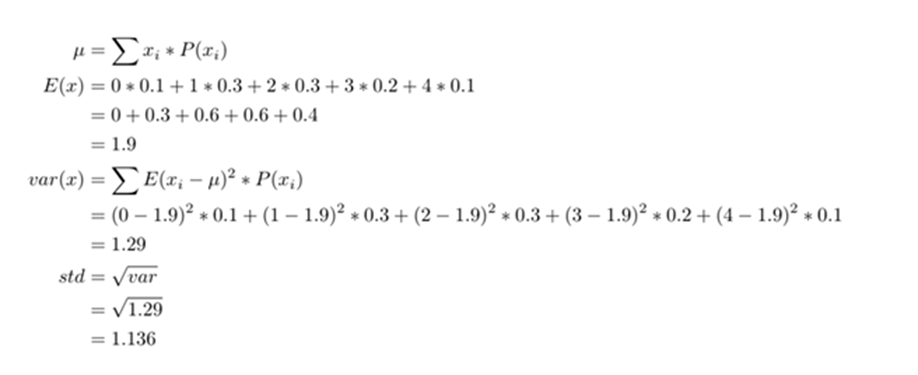
Problem:
Find mean, variance and standard deviation of the following discrete probability distribution

Binomial Distribution
- When Bernoulli experiment is repeated ‘n’ number of times then it is called Binomial Distribution.
- It is a discrete probability distribution.
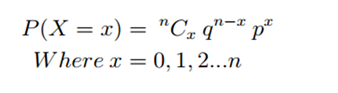
- Probability Distribution which has the following probability mass function (p.m.f) is called Binomial Distribution.
- Parameters are ‘n’ and ‘p’ and Variable X is discrete and called Binomial variate. This is denoted by B(n,p)
- Assumptions: a)Outcome of the experiments should be dichotomous Conducted under identical conditions
- Experiments must be independent
Formula:
Examples:
- Number of defective articles in sample of 6 drawn from lot
- Number of heads obtained in 3 tosses of a coin
- Number of male children in a family of 5 children
Application of Binomial Distribution:
Types of Problems in Binomial Distribution:
- Type I: Finding the probability of events
- Type II: Finding the expected values
- Type III: Finding the distribution if parameters are give
Type I: Finding the probability of events
An unbiased coin is tossed six times. What is the probability that the tosses will result in
- Exactly two heads
- At least five heads
- At least one head
- At most two heads
- Not greater than one head
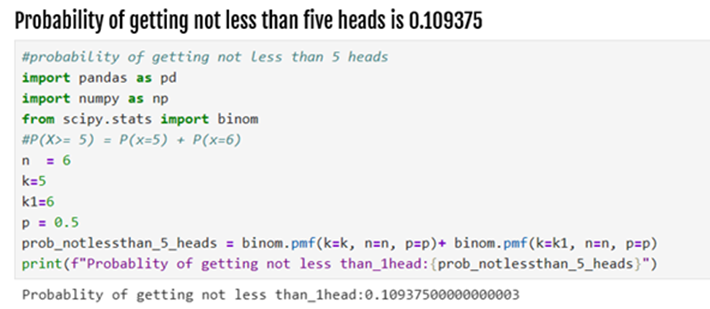
- Not less than five heads
-
Exactly two heads:
Let ‘A’ be the event of getting head.
- p=1/2
- q=1/2
- n=6
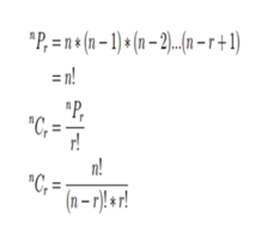
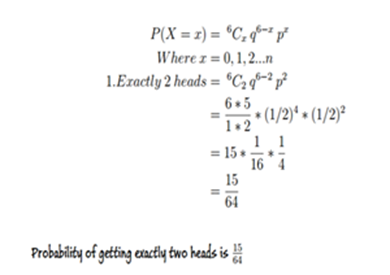
Probability of getting exactly two heads is P(X = 2) =0.234375
Using python : use scipy.stats package and stats library
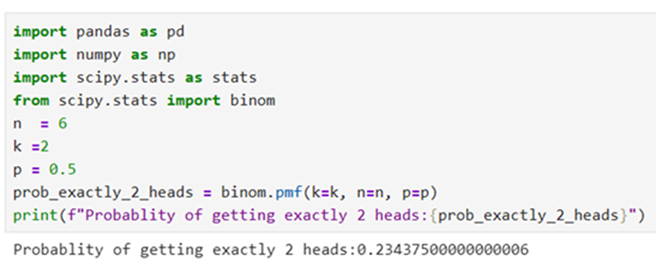
use scipy.stats.binom.pmf(k, n, p)
where:
- k = number of successes (integer or array)
- n = number of trials (integer)
- p = probability of success in each trial (float between 0 and 1)
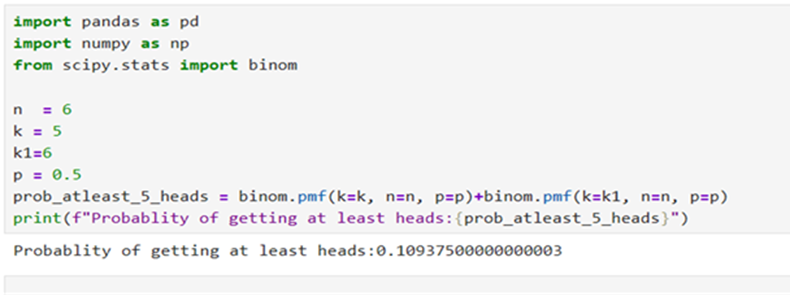
Probability of getting at least 5 heads: means 5 and above
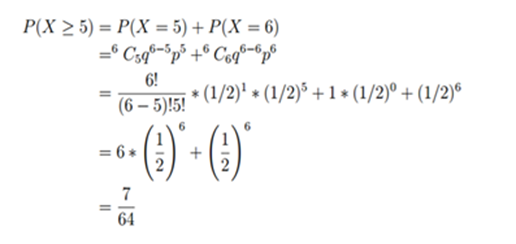
Probability of at least 5 and above (x≥5) is 0.109375
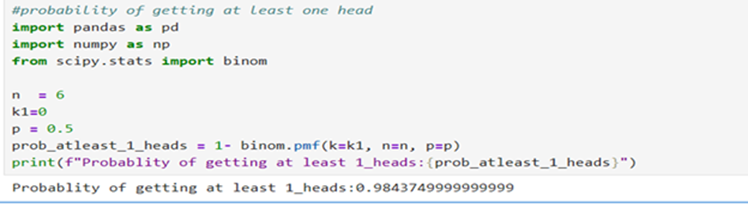
At least one head: means P(x=1..6)
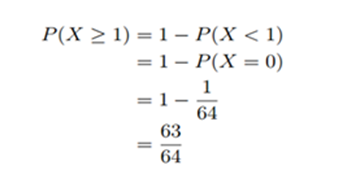
Probability of getting at least one head is 0.98437. Instead of finding P(X=1),P(X=2),P(X=3),P(X=4),P(X=5), and P(X=6) and sum the out come we P(X<1) from total probability 1
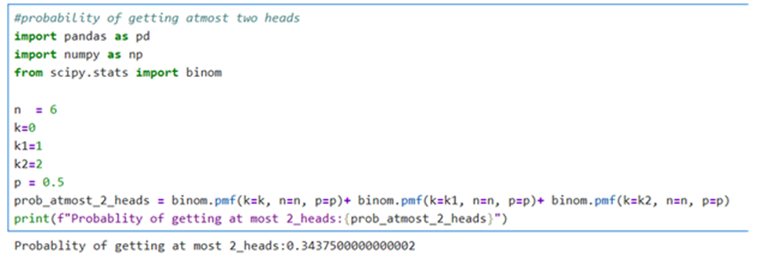
At most two heads: mean we require P(X= from o to 2)
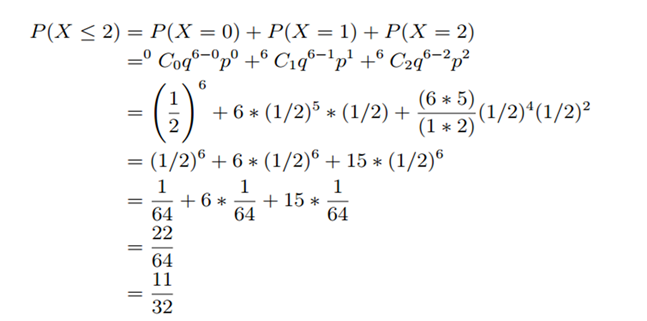
At most two heads include p(x=0), p(x=1), p(x=2) ie p(x≤ 2). . Probability of getting at most 2 heads: 0.34375
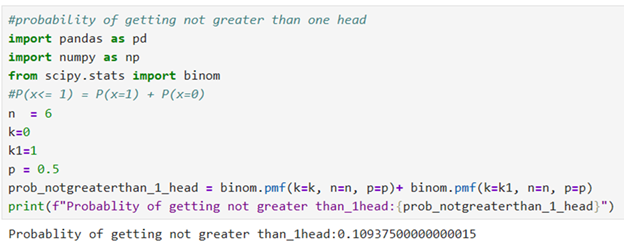
Not greater than one head: means P(x<= 1):
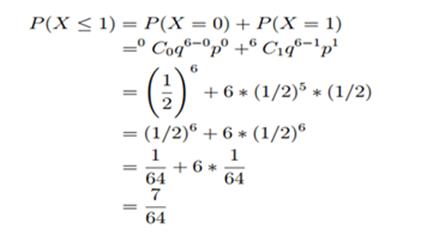
Probability of getting greater than one head ( includes P(x=0) + P(x=1) =0.1093
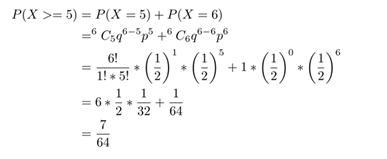
Not less than five heads (includes p(x=5)+P(x=6)):
Type II: Find the expected values E(X) =\mu
- Say a random sample of 5 sachets of coconut oil was examined.
- Two were found to be leaking
- Dealer received 625 packets each containing 5 sachets.
- Find the expected number of packets to contain exactly one sachet leaking?
Solution:
- n=5
- N= 625
- PROBABILITY OF LEAKING p = 2/5
- q = 1 –p = 1- 2/5 = 3/5
- Expected number of sachets Contains exactly one leaking
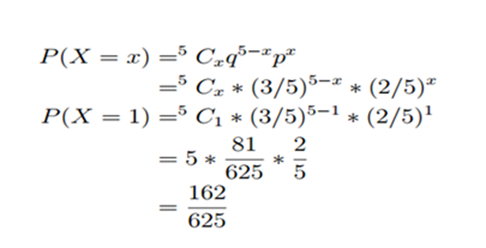
Expected number of packets to contain exactly one leaking sachet is
N * Probability = N*P(X=1)= 625*162/625 = 162
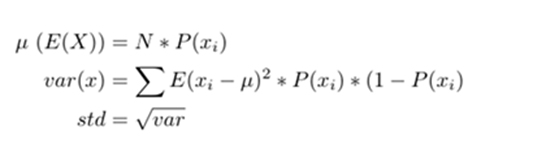
Formulae for finding mean, variance and std for Binomial distribution:
Another Problem:
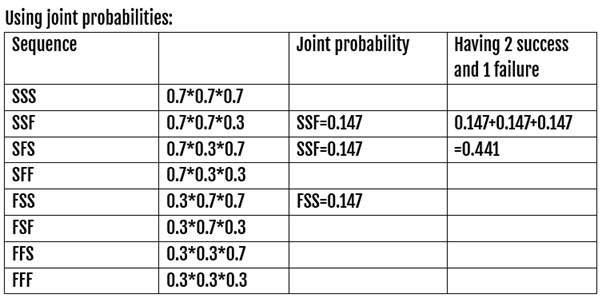
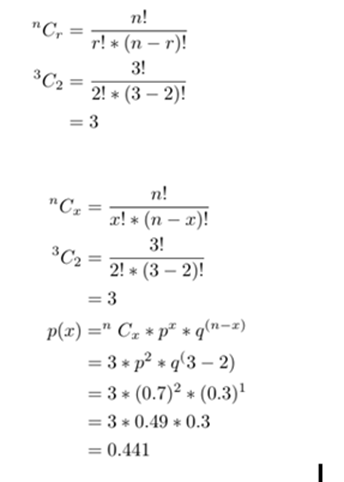
Researchers found that 70% of the owners accounting app understand how to program the app. You select Randomly 3 owners. What is the probability that exactly 2 of the owners know how to program the app (ie with p=0.7 , the probability of selecting exactly 2 owners out of 3 trials. Use S for Success and F for failure
Using Joint Probabilities
Using formula
n = Possible outcome of sequence of 2 success and one failure
Type III: Finding the distribution
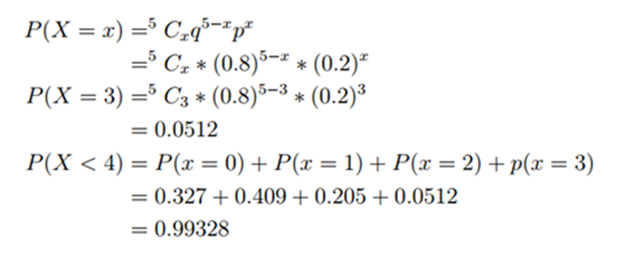
- For a Binomial distribution with n=5 and p=0.2
- Find P(X=3)
- Find P(X < 4)
- n and p are given find q
- p = 0.2 , q= 1- p = 1-0.2=0.8
- Distribution
Find out the fallacy:
You are given
- Mean of Binomial distribution is 4
- Variance of Binomial distribution is 5
Solution:
- Mean = np =4
- Variance = npq=5
- q=npq/np = 5/4= greater than 1. It can not be
- p+q must always be equal to 1
So the given distribution with mean 4 and variance 5 is not a binomial distribution. It is wrong.
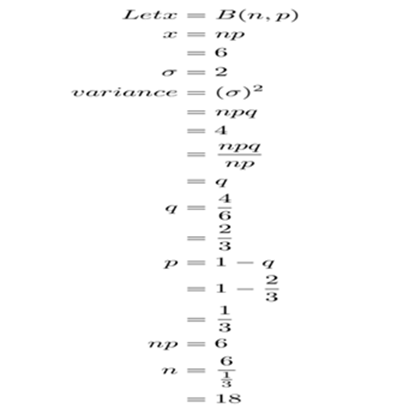
Problem2: Find the number of trials(n) using binomial distribution for which mean and standard deviation are 6 and 2. You are given mean and std of binomial distribution. You are required to find out the number of trials (n) done.
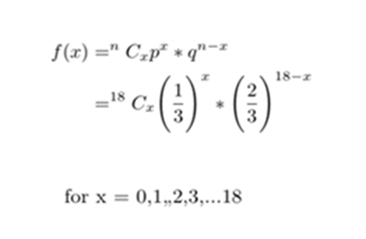
Probability of mass function after finding out the number of trials made
Hypergeometric Distribution:
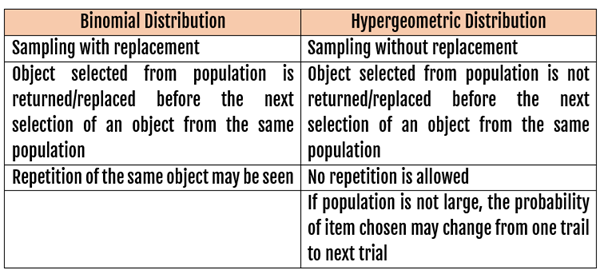
- It is similar to Binomial distribution
- Similar to BD it focuses on the number of successes (p) in a given number of consecutive trials
- But Consecutive trials are not independent
- The outcome of trial differs from the outcome of earlier trials
- the probabilities of success do not remain constant. It points out to sampling without replacement concept
- Hypergeometric Distribution does not rely on a Bernoulli Process
Hypergeometric Distribution:
Probability(x)
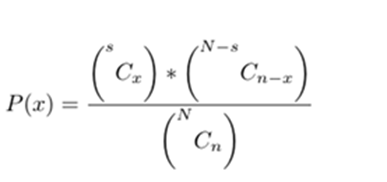
Where:
N = Size of the population
S = Number of successes in the population
n = Size of the sample
x = Number of successes in the sample
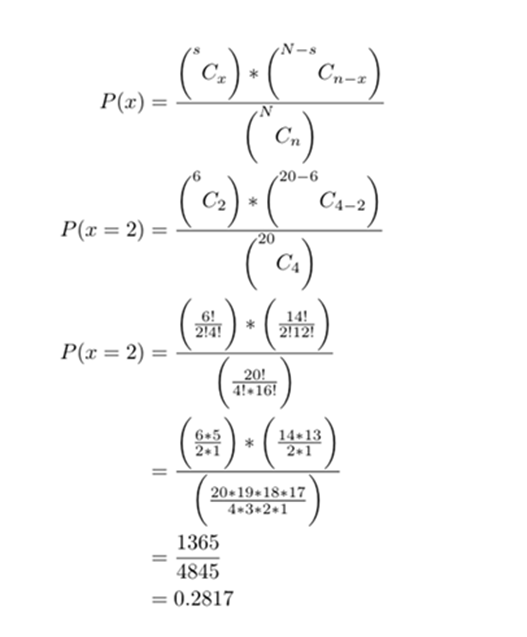
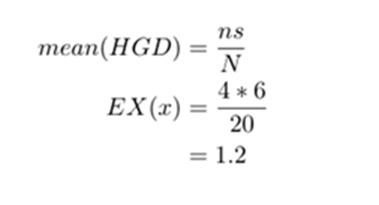
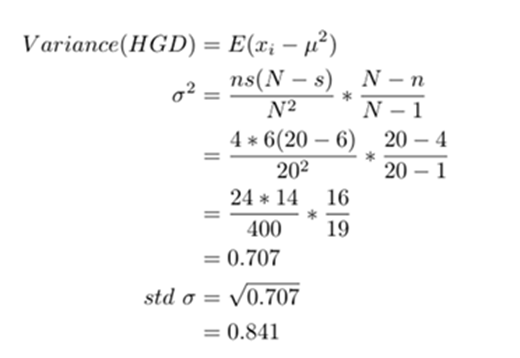
Say there are N=20 pages in a book. Out of that s=6 pages are incorrect. When you select randomly n=4 pages from the population what would be probability of getting exactly 2 pages are incorrect.
N=20; n=4; s=6 and p(x= 2)
Mean for Hypergeometric Distribution
Variance and standard deviation:
If we repeat this procedure for other possible outcomes of X (the number of incorrect pages) we would get the probabilities as shown below: X is the number of incorrect pages

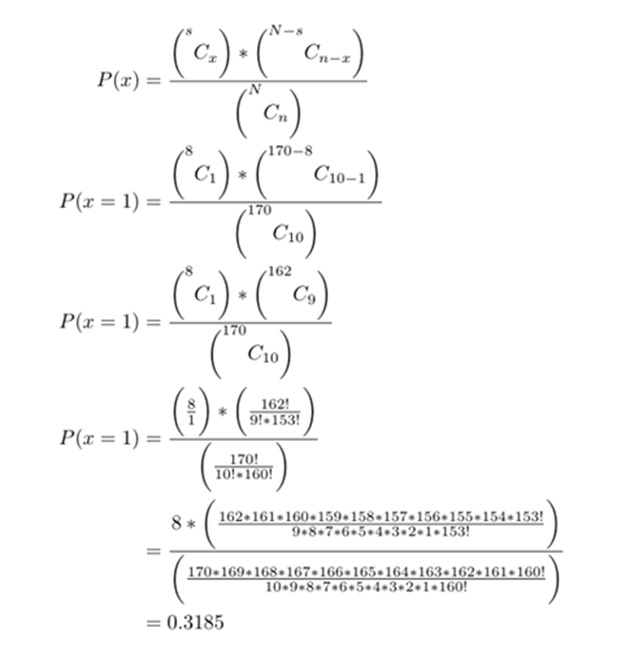
Another example: Over the course of a year, there were 170 births(N), in the town, Westford including 8 children born to young (under age 20) mothers. If 10 (n) individuals were randomly selected from 170(N) born that year, what is the probability that exactly one person(x) would have been born to a mother who was under the age of 20.
Solution:
N =170; n=10; s=8; P(x=1)
Poisson Distribution
- Poisson Process is obtained when binomial experiment is conducted many numbers of times . Here the n is number of trials would be a large number.
- It is also a discrete probability distribution.
- The probability of success ‘p’ is small and the number of trials ‘n’ is large
- When n is large and probability is small Binomial distribution is approximated to Poisson Distribution.
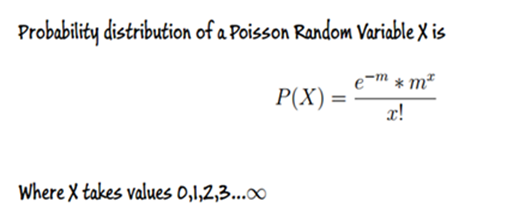
- m is mean number of successes in the given time interval
- The mean and variance of the distribution is ‘m’. Unimodal distribution
- The standard deviation is square root of m. This is the parameter of Poisson
- Mean (m) = np
- e = 2.7183
- P is the probability of success and n is the number of trials
Assumptions:
- The outcome or trial must be dichotomous in nature
- The probability of success must remain the same for trials
- Trials must be conducted under identical conditions.
- Trials must be independent
- Probability of success is small and n is very large
Examples:
- Number of accidents in any traffic circle
- Number of incoming telephone calls at an exchange per minute
- Number of defects in a product
- Number of customer arrivals to teller during a given period of time
- It is useful in management technique called queuing theory(waiting-line)
Types of Problems in Poisson Distribution:
- Type I: Finding the probability of events
- Type II: Finding the expected values
- Type III: Finding the distribution if parameters are given
Type I: Finding the probability of events:
Two houses in a thousand catch fire in a year. There are 2000 houses in a village. What is the probability that
- a) None of the house catches fire
- b) At lease one house catches fire
- c) Not more than two houses catch fire
- d) None of the house catches fire:
The probability of a house catching fire
p = 2/1000 = 0.002, n=2000, e= 2.7183
Poisson distribution
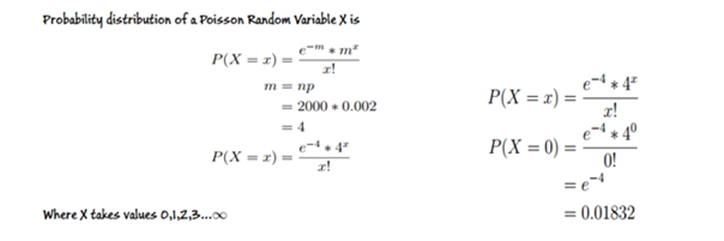
Using Python:
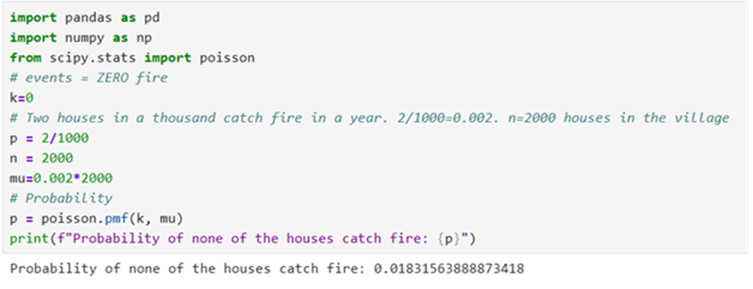
import poisson lib from Scipy.stats package and use poisson.pmf(k,mu) function
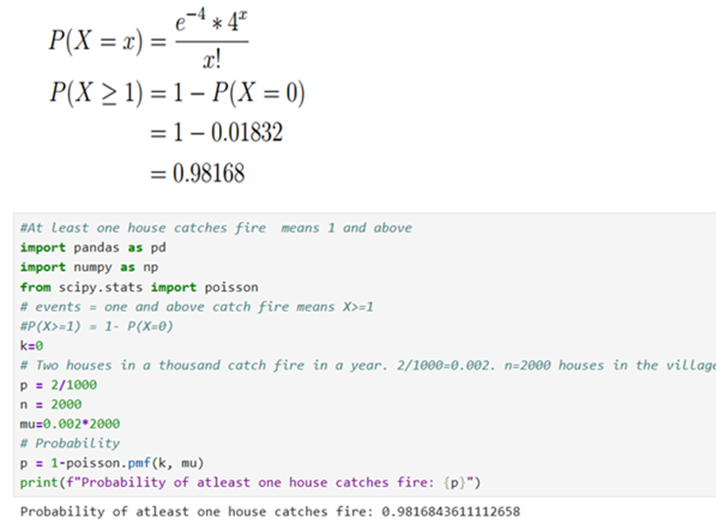
b.At least one house catches fire means one and above houses catch fire. So we deduct the probability of zero house catches fire from 1
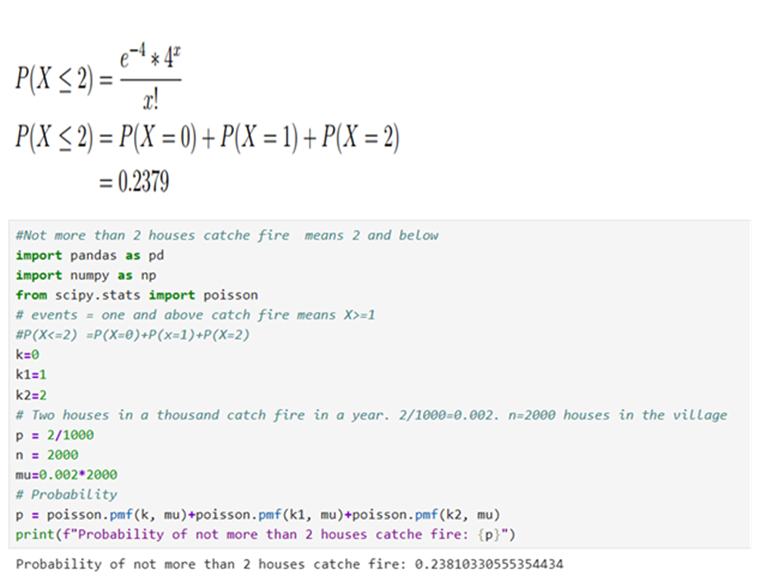
c.Not more than 2 houses catch fire. Should be x must be less than or equal to 2
Type 2: Finding the expectation
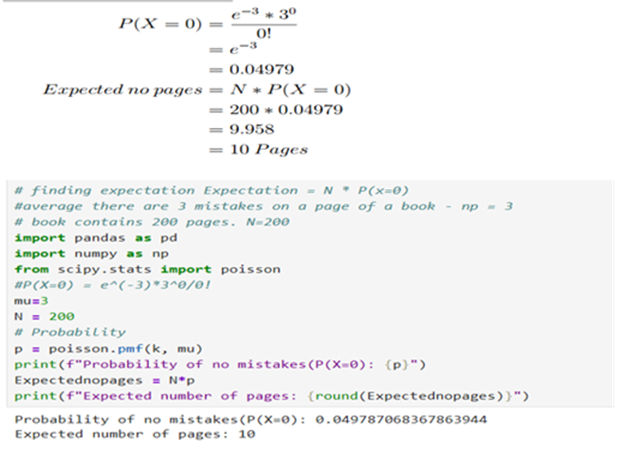
Problem: On an average there are 3 mistakes on a page of a book. The book contains 200 pages. What is the probability that a randomly selected page has exactly one mistake?
Step 1: Find the probability
Type 3: Finding the distribution
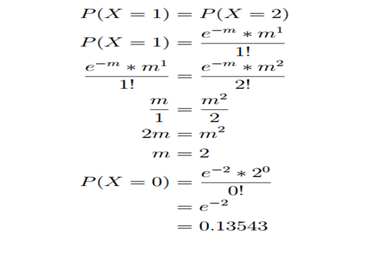
If X is a Poisson variate such that P(X=1) = P(X=2). Find P(X=0) m be the parameter
Fitting the distribution:
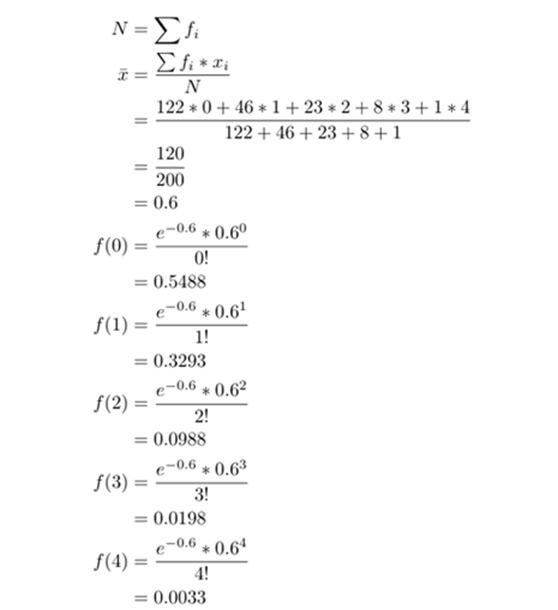
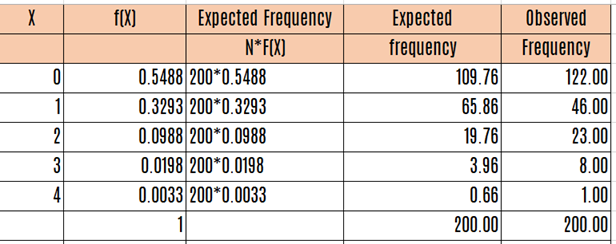
Using the method of moments, you can fit a Poisson distribution to an observed frequency distribution. Since Poisson distribution is uni-parametric, we equate m, the parameter of Poisson distribution, to the arithmetic mean of the observed distribution and get the estimate of m.
m =xba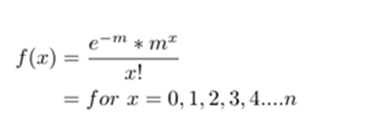
Fit a Poisson distribution to the following data :

Important points in connection with Poisson distribution:
- Since e-m = 1/e^m > 0 , whatever may be the value of m, m > 0, it follows that f(x) ≥ 0 for every x. Also it can be established that f(x)=1 i.e.,
f(0) + f(a) + f(b) + ….… = 1
- Poisson distribution is known as a uni-parametric distribution as it is characterized by only one parameter m
- The mean of Poisson distribution is given by m i.e. µ = m
- The variance of Poisson distribution is given by σ 2 = m
- Like binomial distribution, Poisson distribution could be also unimodal
- or bimodal depending upon the value of the parameter m.
- We have µ0 =
- The largest integer contained in m if m is a non-integer
- m and m – 1 if m is an integer
- Poisson approximation to Binomial distribution: The Poisson distribution can be used as an approximation to the binomial distribution under certain conditions. When the number of trials in a binomial distribution (n) is large and the probability of success (p) is small, the binomial distribution becomes computationally challenging. In such cases, the Poisson distribution provides a simpler and more convenient approximation
The conditions for using the Poisson approximation to the binomial distribution are as follows:
- The number of trials (n) is large, typically greater than 20.
- The probability of success (p) is small, typically less than or equal to 0.05.
- The events occur independently of each other. Then, B(n, p) J P(m)